
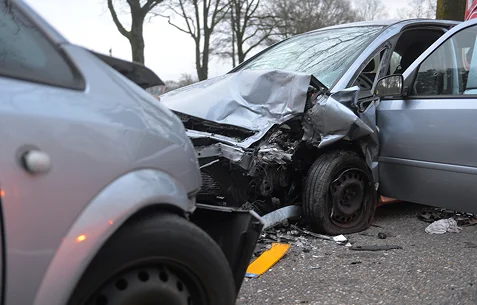
 You are merging back onto I-25 when you glance down at a buzzing phone for half a second, and by the time you look up, you have clipped the car beside you. The officer who responds writes careless driving on the citation, and you keep turning that phrase over, wondering how one distracted second can turn into a charge.
The Law Offices of Susan Deschler understands your concerns about what happened and can bridge the gap between what actually happened on the road and what a prosecutor must prove to secure a conviction.
What Is Careless Driving in Colorado Generally?
Careless driving in Colorado means operating a vehicle in a careless and imprudent manner, without due regard for the road conditions, the traffic, and the conditions around you. It can also be careless driving if a driver fails to yield the right of way to a stationary emergency vehicle. The prosecutor carries the full burden of proof, and the State must prove each element beyond a reasonable doubt. Proof beyond a reasonable doubt is proof that leaves the judge or jury firmly convinced of the defendant’s guilt.
What Does Colorado’s Careless Driving Statute Require?
Prosecutors cannot rely solely on the fact that a collision happened. Colorado law requires them to establish the elements of the offense before a judge or jury can convict, including:
- Identity behind the wheel. The People must show that you were the one driving, not just present at the scene.
- A careless and imprudent manner of driving. The People must show that your driving did not show a level of care for the width, grade, curves, corners, traffic, and other circumstances of the road you were on.
A person who grossly deviates from the standard of care a reasonable person would exercise and fails to perceive a substantial and unjustified risk that a result will occur or that a circumstance exists acts without due regard for safety.
A crash alone does not necessarily establish careless driving. Weather, mechanical failure, another driver’s actions, or a momentary and reasonable misjudgment may provide an alternative explanation for what occurred and create questions about whether the State can prove the required elements beyond a reasonable doubt.
Penalties depend on whether injuries or death result and on the type of careless driving charged.
What Evidence Do Prosecutors Rely On?
Prosecutors may build a careless driving case based on evidence available after the incident, including reports, statements, physical evidence, accident reconstruction, and footage.
The Officer’s Report and Testimony
What the officer wrote at the scene, and what the officer later testifies to, can carry significant weight, particularly if the officer personally observed the driving behavior at issue. If the officer’s report conflicts with the physical evidence, witness accounts, video, or other evidence, those inconsistencies may provide grounds to challenge the prosecution’s version of events.
Witness Statements
Other drivers, passengers, or bystanders may describe specific examples of careless driving they observed, such as lane drift, a following distance that closed too quickly, or a driver who appeared distracted. Their memory of a fast-moving event may become part of the evidence the prosecutor uses to build the case.
Physical Evidence at the Scene
Skid marks, vehicle positioning, damage patterns, and road conditions can all support or undercut the State’s theory of what occurred. The way officers or investigators document and interpret this evidence can also become important when the defense evaluates whether the physical evidence actually supports the prosecution’s account.
Photos, Video, and Data
Traffic cameras, dashcams, and a vehicle’s event data recorder, when available, can provide additional evidence of what actually happened in the seconds before impact, sometimes contradicting the officer’s or witness’s initial account.
How Can a Defense Attorney Challenge the Evidence?
A defense attorney can challenge weaknesses in the State’s evidence at different stages of the case, including during negotiations, pretrial proceedings, and trial. Your defense attorney may:
- Examine the officer’s basis for the citation. An officer who was not on scene when the driving occurred, arrived after the fact, or pieced together events from a dispatch call may have a weaker foundation than one who watched the entire sequence unfold. Determining exactly what the officer saw, rather than what they inferred or learned from others, can help identify potential weaknesses or inconsistencies in the State’s case.
- Challenge witness reliability. Memory of a sudden, unexpected event can vary among witnesses, and discrepancies between what a witness told the officer and what a witness later says in court may undercut the account.
- Introduce an alternative explanation. Ice, a mechanical failure, or another driver’s sudden action may provide an explanation for the incident that challenges the State’s claim of careless driving.
- Scrutinize the physical evidence. Skid marks and damage patterns do not always point to a single explanation, and an officer’s interpretation of the scene may be tested against photographs, vehicle data, witness accounts, and other available evidence.
- Seek an expert. An accident reconstructionist can review the case, provide a report, and serve as an expert for the defense.
Each of these approaches targets a specific weakness in how the State assembled its case, rather than simply asking a judge or jury to take the driver’s word over the officer’s.
Still Asking, What Is Careless Driving? Contact the Law Offices of Susan Deschler
Understanding the charge is only part of determining how to respond to it. Susan Deschler has practiced law for over 25 years and has handled criminal matters since 2003. She moved her practice to Colorado in the spring of 2015 and served as a Deputy District Attorney for the County Court in Clear Creek County. She has since gained deep experience in the courts of Summit, Clear Creek, Grand, Gilpin, Jefferson, and Eagle Counties.
As a solo practitioner, Susan works directly with her clients herself, not through staff, and her recognition, including two American Institute of DUI/DWI Attorneys awards for Ten Best Attorneys and a high Avvo Rating, reflects a career built on experience. She personally reviews the evidence in each careless driving case, just as she would want it reviewed if she were the one standing on the roadside.
Take the First Step Toward Experienced Help Today
A careless driving charge does not have to end in a conviction, and the evidence behind your charge may be weaker than it looks on paper. Susan Deschler can review the officer’s report, the witness accounts, and the physical evidence in your case to find where the prosecutor’s allegation falls short. Schedule your consultation today to learn about your options.
Legal References Used to Inform This Page:
To ensure the accuracy and clarity of this page, we referenced official legal and other resources during the content development process:


